LEADERSHIP
How I lead
Every organisation I've joined has faced different challenges, but my role has been remarkably consistent: build stronger teams, provide clarity when change creates uncertainty, and improve the systems that help great work happen consistently. The examples below show how I approach each.
Building teams
Great teams don't happen by accident. They're built deliberately. My role isn't to produce great designers, it's to build an environment where talented people can grow, challenge one another and do the best work of their careers.
I look for curiosity over certainty, judgement over process, and people who care more about solving the problem than owning the solution. Skills can be taught. Attitude, humility and ambition are much harder to develop.
Growth doesn't happen through performance reviews. It comes from clear expectations, regular coaching and progressively larger opportunities. My job is to create enough support for people to succeed, and enough challenge that they continue to grow.
The outcome isn't simply stronger designers. It's teams that make better decisions, take greater ownership and raise the standard for everyone around them. Over time, leadership becomes something the organisation produces, rather than something it depends on.
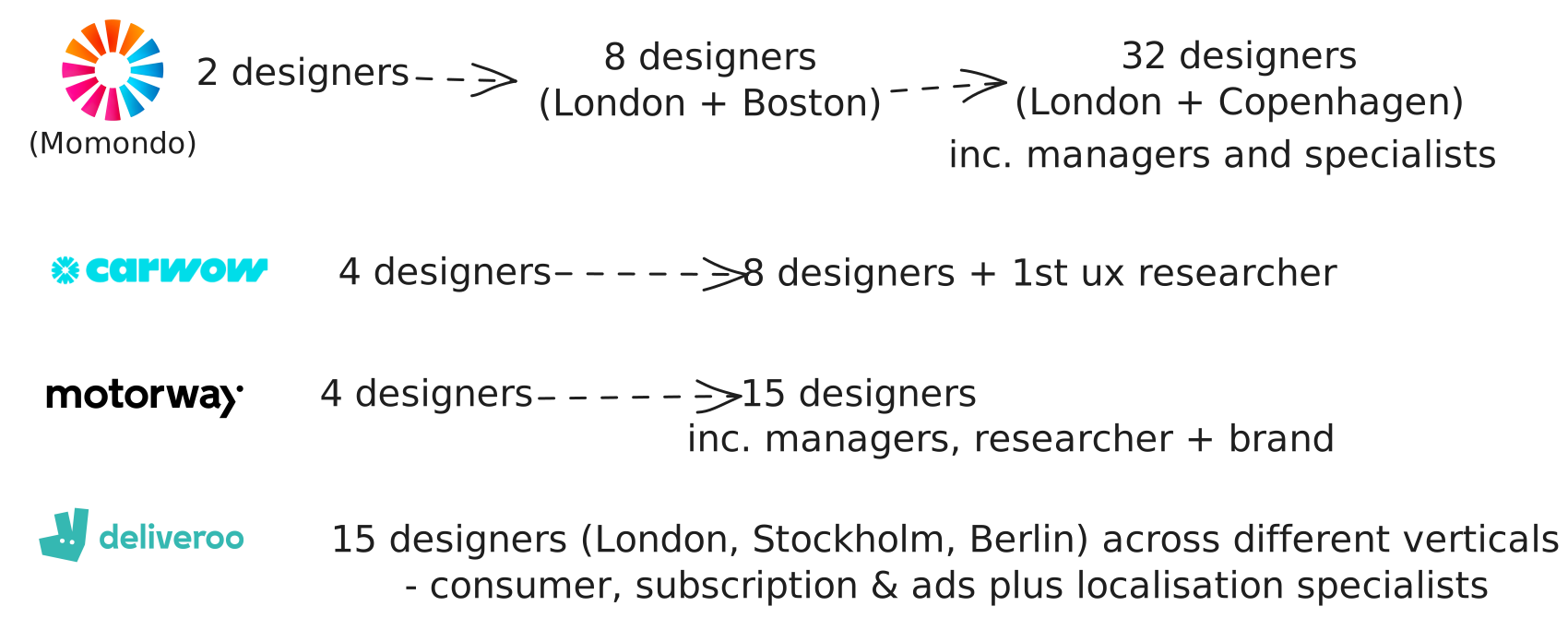
I've built teams in start-ups, scale-ups and publicly listed companies. I've hired for a variety of disciplines across design and research including hiring and supporting the growth of managers. I prefer team that are learn and sharp and entirely tuned into the need of the business. High retention has been a consistent outcome, but it's a consequence of a healthy culture, not the goal itself.
Leading through uncertainty
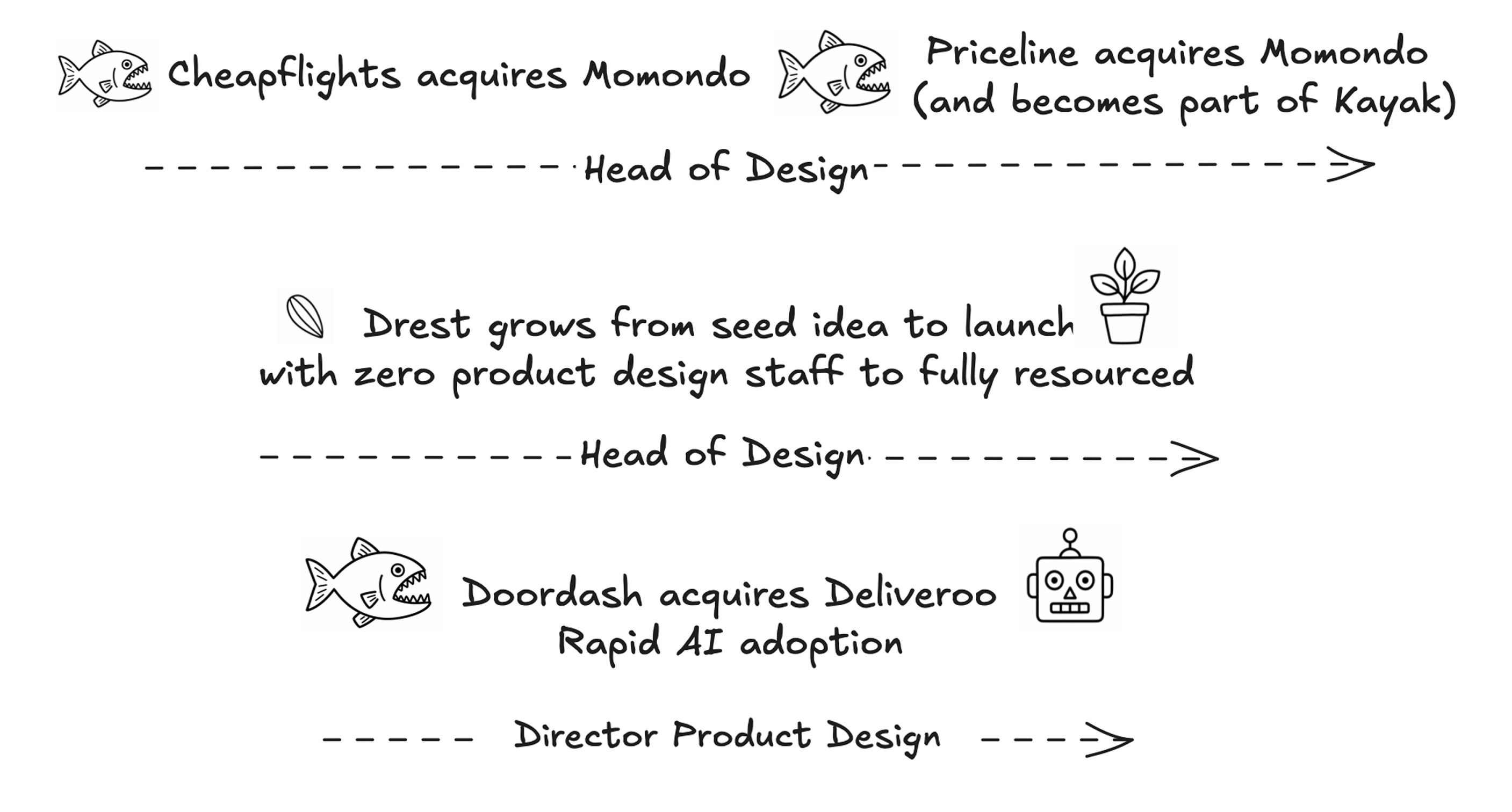
Leadership is tested when certainty disappears. Acquisitions, restructures and new technology create uncertainty long before they create clarity. In those moments, people don't expect leaders to have every answer. They expect them to create enough confidence that good work can continue.
My role is to separate facts from assumptions, decisions from discussion, and priorities from noise. Being clear about what has changed, what hasn't, and where teams should focus their energy.
Honest communication builds trust faster than false certainty. Saying "I don't know yet" is often more valuable than offering an answer that won't survive the next leadership meeting. People cope remarkably well with uncertainty when they understand why it exists.
During periods of change I increase visibility, not control. More regular communication. Clearer priorities. Frequent one-to-ones. The aim is to reduce unnecessary uncertainty so teams can concentrate on delivering meaningful work.
Uncertainty is inevitable. Confusion isn't. Good leadership can't remove uncertainty, but it can create enough clarity that organisations continue making good decisions while the future unfolds.
Raising the bar
Great organisations don't rely on exceptional individuals. They create systems that help ordinary teams produce exceptional work.
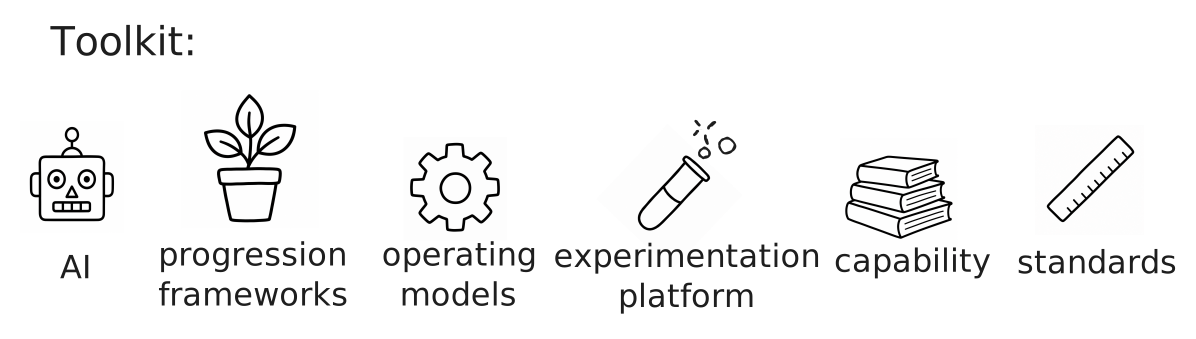
Raising the bar means improving how an organisation works, not just what it produces. Shared standards, clearer expectations and better ways of working make quality more consistent and allow teams to move faster with greater confidence.
Capability isn't built through a single initiative. It grows through hundreds of improvements that reinforce one another; progression frameworks that make expectations clear; design standards that improve consistency; AI proficiency that changes how designers work; operating models that remove friction instead of adding it.
The best leadership leaves an organisation in a better place than it found it. Better equipped to make decisions, develop people and sustain quality long after individual leaders have moved on.
The following case studies show that philosophy in practice.
- Ai transformation
Helped enact an Ai proficiency framework across a large design organisation; translating strategic direction into workflows, expectations and capability development after the DoorDash acquisition.
- Scaling consumer growth
Led Product Design across Consumer Growth at Deliveroo, spreading design investment across acquisition, activation, retention and reactivation based on customer data and experimentation, contributing to +13.9% YoY MAU growth and $72.7m annualised GOV.
- Understanding how people buy cars
Commissioned Carwow's first behavioural research programme to understand how people buy cars, then turned that insight into product strategy and a mobile proposition built around real-world moments of interest.
- Looking beyond the product
Extended Motorway beyond the online auction into a managed collection experience, closing the gap between a completed transaction and the handover customers remembered most.
- Transforming one of travel's original online brands
Led the end-to-end Cheapflights rebrand across Product, Marketing and Executive leadership, launching fifteen responsive websites, a new mobile app and a global design system.